State Laws
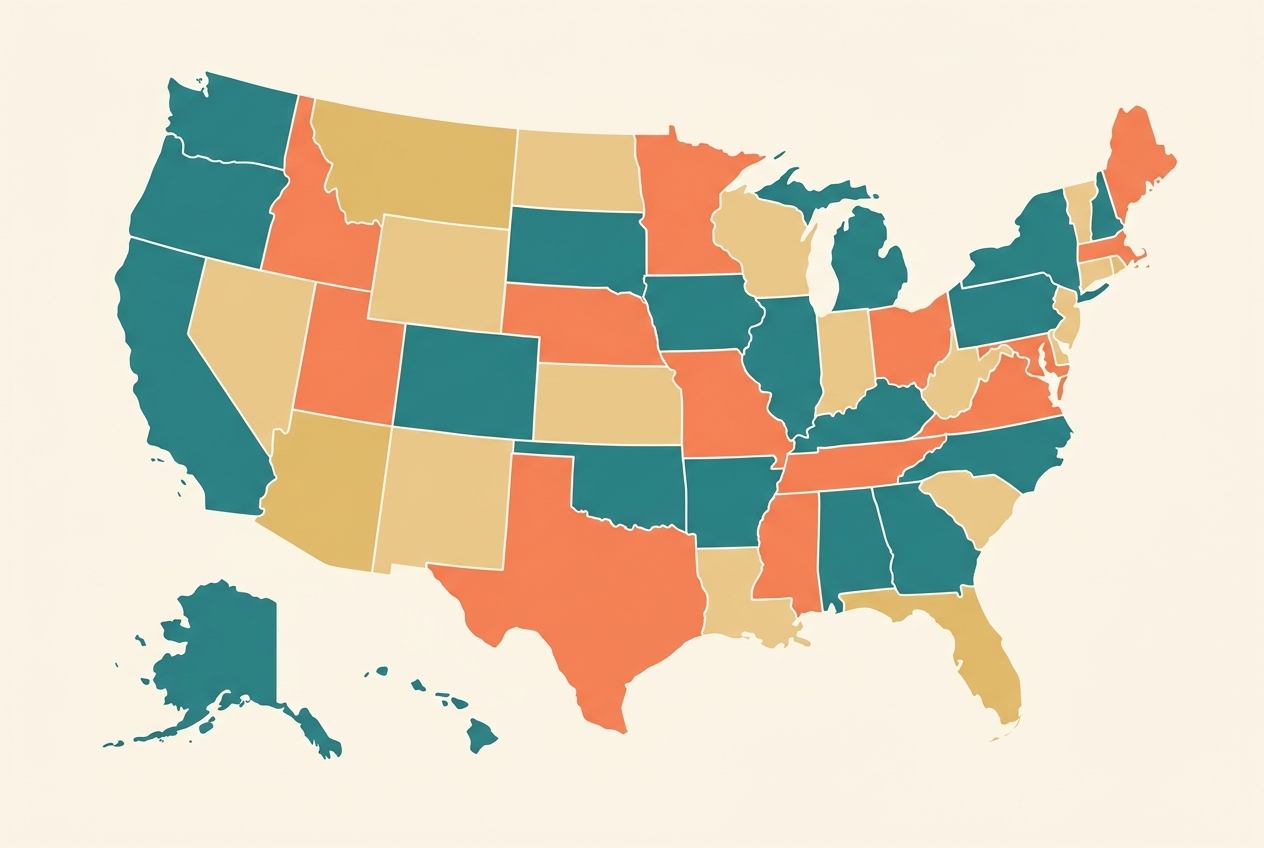
Surrogacy Laws by State: The 2026 Map
September 19, 2026 · 10 min read · On Fertility Ground Surrogacy
Last reviewed September 2026. This is general education, not legal advice. Surrogacy law is state law, it changes, and the details matter enormously — always confirm with a licensed reproductive attorney in the relevant state before signing anything or transferring an embryo.
There is no federal surrogacy law in the United States. Whether your agreement is enforceable, whether the intended parents can be named as parents before birth, and whether the surrogate can be paid at all are all decided state by state. Two families can run identical journeys and end up with completely different legal footing.
Here's how to read the map — and what actually makes a state safe.
The Three Tiers That Matter
Tier 1 — Explicit statutory protection
These states have passed laws that specifically recognize gestational surrogacy agreements, set out the requirements, and provide a route to a pre-birth parentage order. You know the rules before you start.
California is the benchmark. Family Code sections 7960–7962 recognize gestational surrogacy agreements outright, with no marital-status, sexual-orientation or genetic-connection requirement, and a pre-birth order names the intended parents before the baby arrives. Other states with explicit statutory frameworks include Nevada, Washington, Colorado, Illinois, New Hampshire, Maine, Delaware, Connecticut, New Jersey, Vermont, Rhode Island, Oregon, the District of Columbia and — as of 2025 — Michigan.
Tier 2 — Legal, but with conditions attached
Surrogacy works here, but the statute imposes real limits: who can be an intended parent, whether medical necessity must be proven, whether the agreement needs court validation first. Texas and Florida are the two big examples, and both restrict binding agreements to married couples. New York legalized compensated surrogacy through the Child-Parent Security Act but layered on licensing and residency rules.
Tier 3 — Prohibited or high-risk
Louisiana (La. R.S. 9:2718 et seq.) prohibits compensated gestational surrogacy. It permits only uncompensated surrogacy, for married heterosexual couples where both are genetically related to the child — no donor eggs or sperm — with court approval required before embryo transfer, and civil and criminal penalties for non-compliance.
Nebraska (Neb. Rev. Stat. § 25-21,200) declares compensated surrogacy contracts void and unenforceable. Surrogacy isn't criminalized, but with no enforceable contract and no pre-birth order available, families typically fall back on post-birth adoption. That is a materially worse position to be in.
Arizona and Indiana both have statutes declaring surrogacy contracts void. In practice their courts have granted parentage orders in some cases — but "the judge might" is not the same protection as "the statute says."
The tier lists above name the states we can support from published statutes and the ASRM state-by-state resource as of September 2026. They are illustrative, not an exhaustive 50-state ruling. For the official picture, see the ASRM state-by-state surrogacy resource and a local attorney.
What Actually Makes a State "Good" for Surrogacy
Forget the colour on the map for a second. Five questions decide how protected you are:
- Is a gestational surrogacy agreement enforceable by statute? Not "not prohibited" — actually recognized in law.
- Is a pre-birth order available? This is the difference between the intended parents being on the birth certificate at the hospital and filing an adoption months later. See our pre-birth vs. post-birth comparison.
- Are there restrictions on who can be an intended parent? Marital status, sexual orientation, and genetic-connection requirements exclude a lot of families.
- Is compensation permitted? Some states allow altruistic surrogacy only.
- Does the surrogate get independent counsel and clear protections? A state that protects only the intended parents isn't a safe state.
Whose State Controls?
This is the question people get wrong most often. In general the state that matters most is where the surrogate lives and gives birth, because that's the jurisdiction whose court issues the parentage order and whose vital records office issues the birth certificate. The intended parents' home state, the clinic's state and the agency's state can all differ from it.
The practical consequence: intended parents in a restrictive state are usually not stuck. Working with a surrogate who lives in a protective state is a completely normal, well-established path — it's a large part of why California agencies serve families nationwide and internationally.
State-by-State Deep Dives
- California — the gold standard, and where we're based
- Michigan — from the most restrictive state in the country to a protective one, as of April 2025
- Texas — legal with real conditions, including court validation
- Florida — legal, but limited to married couples with medical necessity
- New York — the Child-Parent Security Act, licensing, and the Surrogates' Bill of Rights
- Illinois — parentage at birth by operation of law, plus a bonded escrow requirement
- Nevada — enforceable agreements, separate counsel required, surrogate picks her physician
- Washington — bodily autonomy written into the statute, and a cap on journeys
- Colorado — the 2021 Surrogacy Agreement Act, with no marital-status requirement
If You're a Surrogate in a Restrictive State
If you live in Louisiana, Nebraska, Arizona or Indiana, please don't take an agency's word that "it'll be fine." Ask directly: is my agreement enforceable where I live, can a pre-birth order be issued here, and if not, what exactly happens at the hospital? A good agency will answer plainly and, if the answer is bad, will tell you so.
Not sure where you stand? Our 2-minute quiz asks where you live and we'll tell you honestly what your options look like — including if the honest answer is that your state makes it difficult.
For the national data behind all of this, see our cited 2026 surrogacy statistics.
Ready to Learn More?
Whether you're considering surrogacy as a surrogate or an intended parent, we're here to answer every question personally.
Email us at info@onfertilityground.com — We answer every inquiry personally.
General education, not legal advice. Statutes cited as of September 2026 and subject to change. On Fertility Ground is a surrogacy agency, not a law firm; every journey involves independent legal counsel for both the surrogate and the intended parents.