Intended Parents
Fresh vs. Frozen Embryo Transfer: What the Science Says in 2026 (And Why Surrogacy Uses Frozen)
August 27, 2026 · 8 min read · On Fertility Ground Surrogacy
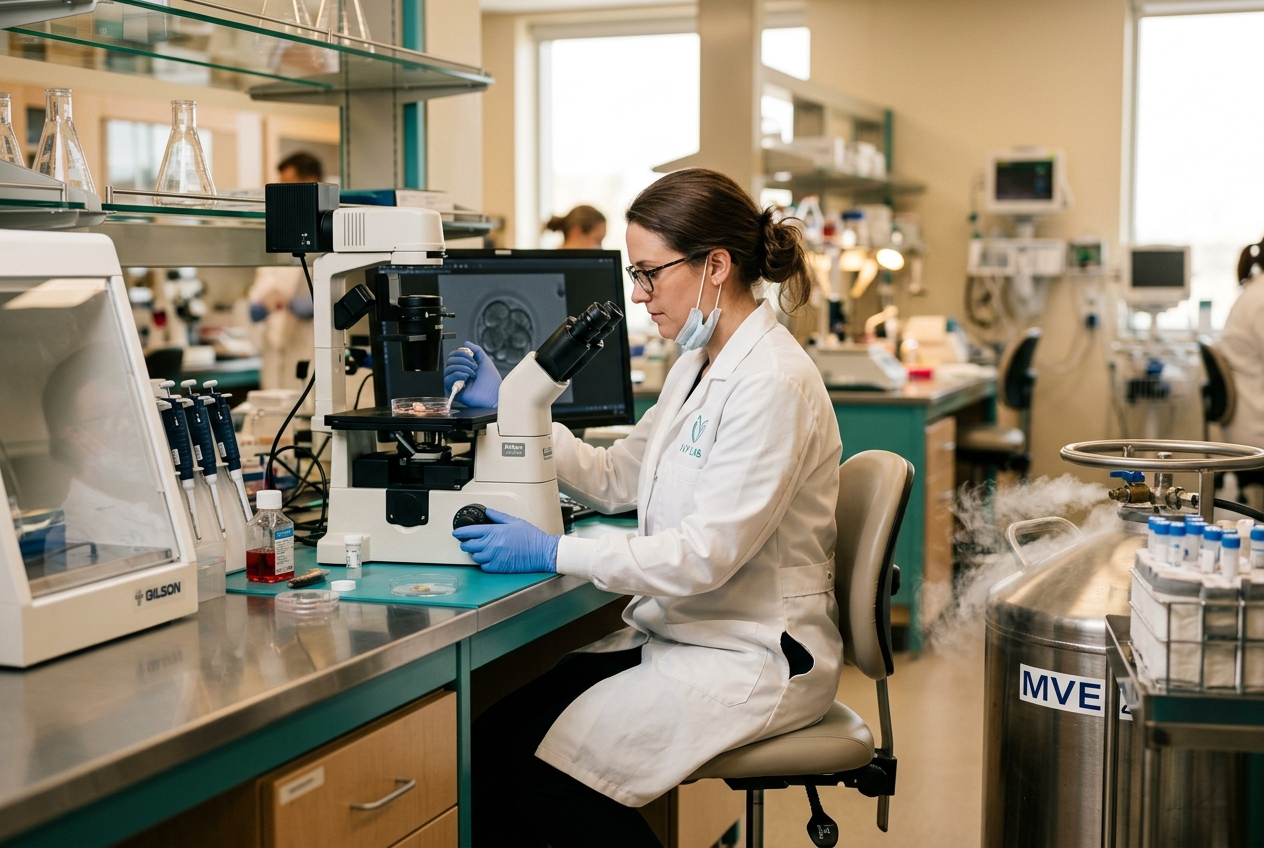
If you researched IVF a couple of decades ago, you learned a firm rule: fresh embryos beat frozen ones. If you're researching surrogacy today, you'll notice something odd — virtually every gestational surrogacy transfer uses a frozen embryo, and nobody seems worried about it. Here's what changed, and why frozen isn't the consolation prize anymore.
The Technology That Flipped the Field: Vitrification
Old-style "slow freezing" formed ice crystals that damaged embryos — many didn't survive thaw, which is where the fresh-is-best rule came from. Modern vitrification flash-freezes embryos so fast that ice never forms; the embryo becomes glass-like and stable. Survival rates after thaw at good labs now run in the high 90s percent. Once thaw survival stopped being the bottleneck, the entire fresh-vs-frozen calculus changed.
What the Evidence Says Now
- Success rates are comparable — and in some groups frozen wins. Large trials and registry data show frozen transfers matching fresh for most patients, with advantages in specific situations. One consistent finding: transferring into a body that isn't simultaneously recovering from egg-retrieval hormones gives the uterine lining a more natural environment.
- Genetic testing requires freezing anyway. PGT-A — the chromosome screening most surrogacy embryos undergo — takes days to result, so biopsied embryos are frozen while the lab works. Tested-and-frozen has quietly become the standard package, and it's a big reason single embryo transfer works so well: you're transferring one embryo you already know is chromosomally normal.
- Frozen pregnancies show fewer of some complications (like low birth weight associated with fresh transfers), though researchers continue studying trade-offs. The clinical consensus: for gestational carrier cycles, frozen is the appropriate default.
Why Surrogacy Specifically Runs on Frozen
Beyond the science, there's beautiful logistics. A fresh transfer requires synchronizing two women's cycles precisely — the egg provider's retrieval and the carrier's lining — across what are often different cities and clinics. A frozen transfer decouples the timelines completely: embryos are created and banked whenever the intended parents are ready, then the surrogate's medication cycle is scheduled around HER life — work calendar, kids' school year, travel. Embryos wait patiently in cryostorage; science has seen healthy babies born from embryos frozen for well over a decade.
What This Means for Your Journey
- Expect a "freeze-all" cycle: create embryos → PGT test → freeze → transfer one at a time on a planned calendar
- Budget for cryostorage (a few hundred to ~$1,000/year) — line-itemed in our cost guide
- Remaining embryos are your future sibling journey, already made — one of frozen's quietest gifts
- If a transfer fails, the next frozen embryo is ready without a new retrieval — see what happens after a failed transfer

From Our Founder
Bree — Founder & CEO, On Fertility Ground
Intended parents sometimes arrive apologetic about their embryos being frozen, like they're offering us day-old bread. I love watching that worry dissolve when they learn the truth: frozen is how we give their embryo a calm, perfectly prepared landing — and how we schedule transfer day around a surrogate's real life instead of a lab's stopwatch.
The best transfer isn't the freshest one. It's the one where everybody — embryo included — arrives ready.
— Bree | info@onfertilityground.com · Meet Bree →
Ready to Learn More?
Whether you're considering surrogacy as a surrogate or an intended parent, we're here to answer every question personally.
Email us at info@onfertilityground.com — We answer every inquiry personally.